

AKK Leads a New Path for Weight Loss and Metabolic Interventions
Top Tertiary Hospital Leads the Way! China's First AKK Bacteria Product Human Clinical Trial Results Released! New Progress in Multiple Effects for Weight Loss and Metabolism
In 2004, the Wageningen team in the Netherlands first isolated and identified a mucin-degrading bacterium from the "high-quality feces" of healthy adults, which is now known as Akkermansia muciniphila—AKK bacteria, hailed as the "next-generation probiotic," "longevity bacterium," and "slim bacterium."
Since then, research on AKK bacteria has advanced rapidly, accumulating scientific evidence from improving metabolism to delaying aging. Since 2024, AKK bacteria-related preparations have emerged one after another. For example, "AKKBOOM" under Hong Kong's TIMESHOP brand achieved a record of 150,000 bottles sold in less than half a year after launch, sparking heated discussions in the market. However, the actual efficacy, onset patterns, long-term effects, and safety of these products in obese populations have always been a focus of attention for the public and academia.
From April to September 2025, the randomized, double-blind, controlled human clinical trial titled "Metabolic Remodeling of Akkermansia muciniphila AKK001 in Obese Populations" conducted at Sir Run Run Shaw Hospital affiliated with Zhejiang University School of Medicine provided new answers. As the first clinical study of an AKK preparation led by a top tertiary hospital and targeting metabolic interventions in obese populations, it systematically evaluated improvements in body morphology, metabolic indicators, liver and kidney function, and thyroid function after 1 month and 3 months of intervention.
01
Weight Loss and Lipid Reduction Effects: Quick Onset in the Short Term, Enhanced in the Long Term
This study enrolled 60 eligible obese volunteers (30 in the observation group and 30 in the control group, with no significant differences in baseline data). The observation group supplemented with one capsule of TIMESHOP AKKBOOM Intestinal Light Capsule containing 1.5×10¹⁰ TFU AKK001 before breakfast daily, while the control group received a blank placebo. All participants received unified dietary guidance (daily calorie intake of 1800-2000 kcal), and the study duration was 3 months.
After just 1 month of intervention, the results showed early positive effects of AKK001. In terms of body morphology, the observation group's body weight, body fat percentage, waist circumference, and abdominal visceral fat thickness were significantly lower than the control group (P<0.05). Particularly noteworthy was the change in basal metabolic rate: the observation group reached 1485 kcal/d, significantly higher than the control group's 1412 kcal/d (P=0.001). This indicates that AKK bacteria intervention can activate the body's energy expenditure mechanism in the short term.
Researchers analyzed that this early improvement may be related to AKK bacteria regulating the gut microbiota and increasing the production of short-chain fatty acids (such as butyrate). Short-chain fatty acids can activate heat-producing genes (such as UCP1) in brown adipose tissue, promote energy expenditure, improve insulin sensitivity, and reduce the inhibitory effect of fat accumulation on metabolism, thereby forming an early positive cycle of "increased energy expenditure - reduced fat."
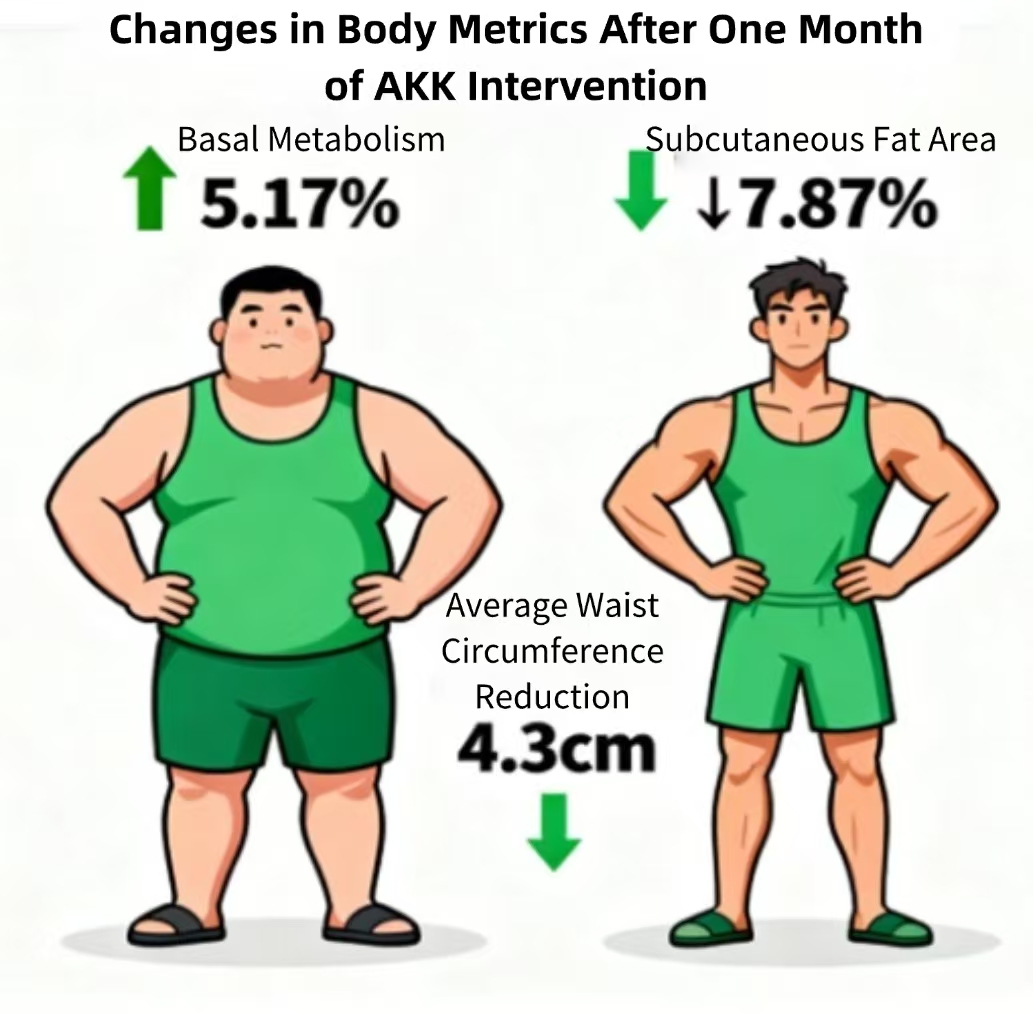
Statistics show that after one month of the experiment, volunteers in the observation group experienced a basal metabolic rate increase of over 5%, subcutaneous fat reduction of about 7.87%, and an average waist circumference reduction of 4.3 cm, highlighting its significant reshaping effect on body morphology.
As the intervention extended to 3 months, the effects of AKK001 showed an "enhancement" trend. The observation group's basal metabolic rate further increased to 1568 kcal/d, with an even more significant gap compared to the control group's 1455 kcal/d. At the same time, body weight, body fat percentage, BMI, waist circumference, hip circumference, and abdominal subcutaneous and visceral fat thickness at all measurement points showed comprehensive declines.
02
Comprehensive Optimization of Metabolic Indicators, Safety Verified
Building on weight loss, the researchers further evaluated the impact of this preparation on key metabolic indicators such as glucose and lipids. They found that after 1 month of intervention, the observation group's blood glucose, triglycerides, and insulin levels had significantly decreased, while high-density lipoprotein cholesterol (HDL-C, or "good cholesterol") levels had significantly increased. At this stage, total cholesterol (TC) and low-density lipoprotein cholesterol (LDL-C, or "bad cholesterol") showed no obvious changes.
After 3 months of intervention, this benefit extended to the entire lipid profile: the observation group's blood glucose, total cholesterol, triglycerides, low-density lipoprotein cholesterol, and insulin levels were all significantly lower than the control group, while high-density lipoprotein cholesterol levels were significantly higher. Among them, triglyceride levels decreased by 21.05%, total cholesterol by 12.24%, and insulin levels by a significant 25.6%.
The study leader pointed out that the characteristic of AKK bacteria is "improving glucose metabolism first, then comprehensive lipid regulation." In the early stage, it may primarily act on glucose metabolism and rapidly turnover lipid indicators, and as the intervention time extends, it achieves systematic optimization of cholesterol metabolism through mechanisms such as inhibiting hepatic cholesterol synthesis and promoting bile acid excretion.
At the same time, the research team monitored multiple indicators throughout the process, including liver function (aspartate aminotransferase, total bilirubin), kidney function (serum creatinine, urea nitrogen), and thyroid function (thyroid-stimulating hormone). The results showed that whether after 1 month or 3 months of intervention, all indicators in the participants remained within normal ranges, with no significant differences from the control group.
03
AKK001 Leads a New Path for Weight Loss and Metabolic Interventions
Industry experts believe that this study not only verifies the effectiveness and safety of AKK001-related preparations in obesity management but also provides new insights into their mechanisms of action: first promoting glucose metabolism balance, then gradually achieving comprehensive lipid optimization. This "quick onset in the short term, enhanced in the long term" path provides safety and efficacy assurances for the clinical application of AKK bacteria as a next-generation nutritional intervention.
As a rapid-onset, long-lasting, and safe intervention solution, AKK001-related preparations are particularly suitable for obese populations with metabolic risks such as hyperglycemia or high insulin levels, offering rapid relief of metabolic stress in the early stage and improving the overall metabolic environment through long-term use. However, the research team also candidly acknowledged certain limitations in this experiment: limited sample size and insufficient follow-up period.
In the future, if combined with larger-scale, long-term follow-up studies, and integrated with precise dietary and lifestyle interventions, it is expected to further enrich evidence-based data, providing more comprehensive solutions for the clinical prevention and treatment of obesity and related metabolic diseases.
If you are interested in AKKBOOM, scan this QR code to order.
Ready to glow and enhance?
📅 Book Your Private Consultation Today
Available in English & Chinese | Strictly Confidential
👉 WeChat: 64482369 (Fastest Way)
📞 +86 138 1124 8726
✉️ beijingpaskincareexpert@gmail.com
PA BEAUTY – Natural Aesthetics for Beijing’s Global Elites
📍 Located in Shine Hills (Xiangyun Xiaozhen), Shunyi – The Heart of Beijing's International Community. (Just minutes from ISB, Dulwich, Keystone, and the villa districts. Only 30 minutes drive from Beijing Capital Airport (PEK) — perfect for layovers, short trips, or busy travelers.)
Book a free consultation today — your upgraded version awaits! ✨


 WhatsApp
 Email
Email
 +86 13811248726